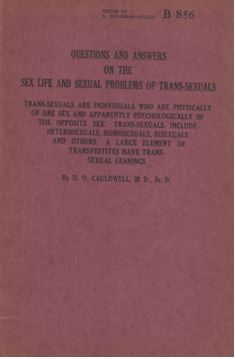
Questions and answers on the sex life and sexual problems of trans-sexuals
This booklet, published in 1950, provides an interesting snapshot of trans life two years before the great shift brought on by news of Christine Jorgensen’s sex affirmation surgery. It consists of letters written by diverse trans people to D. O. Cauldwell, a medical doctor who had acquired a reputation as being an expert on matters gender. Some write in desperation, some to reassure themselves that they’re “normal”; most are baffled by themselves and accept Cauldwell’s medical authority.
 On this, Cauldwell is not as transphobic as one might assume, given the era. His position generally is that the differences between the two acknowledged sexes is not as great as it seems, and is largely a social construct. This view enables Cauldwell to have compassion for his letter writers, but it also oversimplifies the complexity of gender and how individuals identify with it. The range of trans identities represented here is far more varied than the dichotomy of transsexual-transvestite that became the template in the medical community in later years.
Consequently, the title is deceiving for modern readers, as the term “trans-sexual” serves here as an umbrella term for what we’d call “transgender”. There are indeed transsexual people writing for help, but also people whom we’d recognize as non-binary.
Regarding transsexual people, Cauldwell has no understanding. “There is no necessity for an individual who is a member of one sex to cultivate a persistent attitude that he or she is sexologically (or biologically) of the wrong sex.” He declares that “being metamorphosed into an individual of the opposite sex” cannot be done by medical or surgical means. At the time, this was probably true, although all that would change in two years. He also asserts that taking hormones would not result in breast development, which is demonstrably not true. He regards changing the shape of your sex organs as “mutilation”.
However, regarding non-binary people he is more sympathetic, and has no “rational objection to the term mental or psychic hermaphroditism”.
This booklet is interesting both in understanding historical attitudes to trans people, and in reading the stories of our trans ancestors. And for those still flogging the tired theory that being trans is a trend, Cauldwell’s conclusion from 1950 that being trans “is far more prevalent than it is suspected of being” is a fitting rebuke.
“Questions and answers on the sex life and sexual problems of trans-sexuals” is available for viewing at the Ottawa Trans Library.
 Trans Ottawa